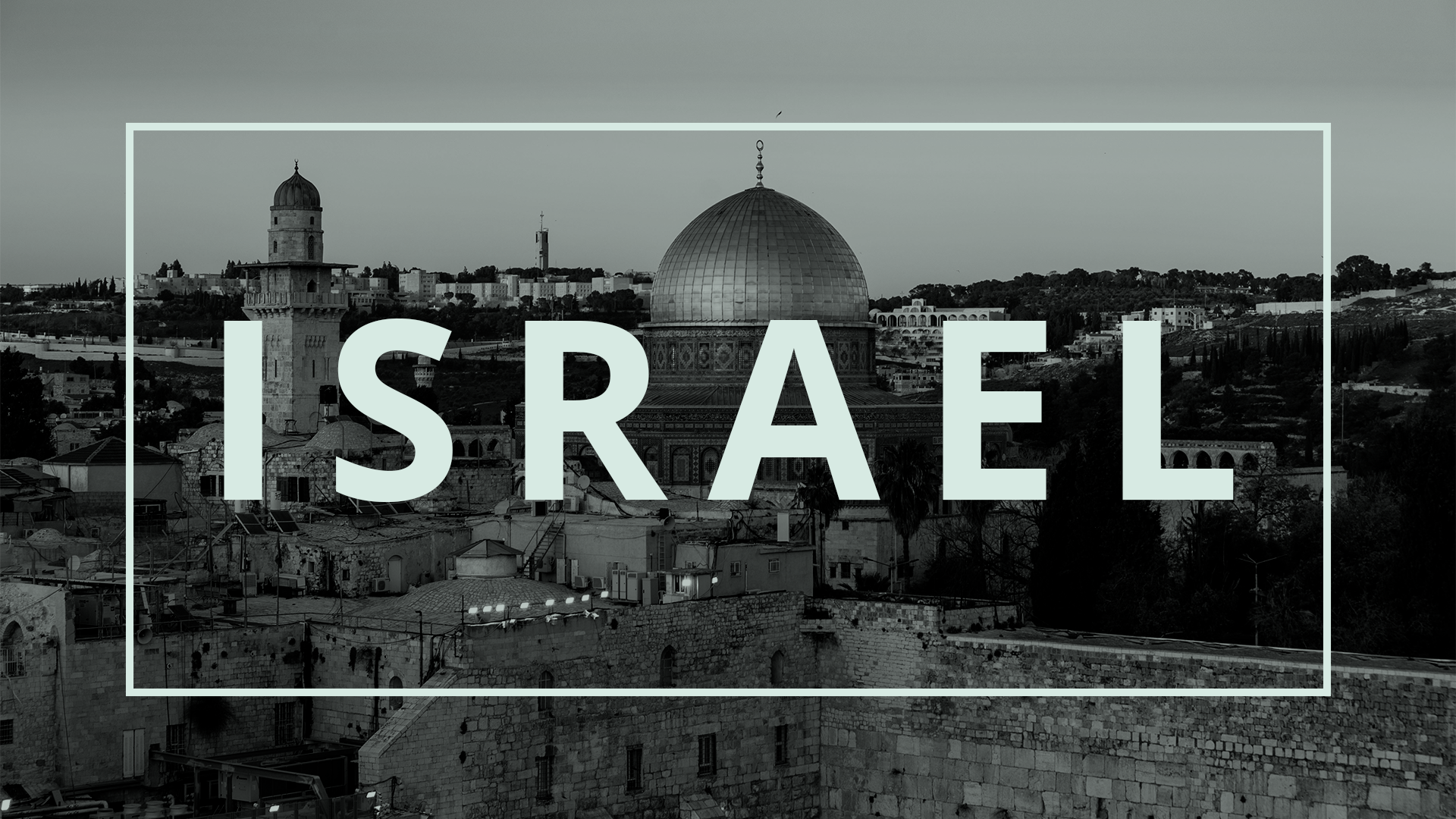
Israel. A single word with so many potential meanings.
A name for a patriarch.
A people.
An ancient kingdom.
A modern nation.
The name/word first appears in the Bible in Genesis 32:28-29,
Then He said to him, “What is your name?”
“Jacob,” he said.
Then He said, “Your name will no longer be Jacob, but rather Israel, for you have struggled with God and with men, and you have overcome.”
The name “Israel” likely originates from two Hebrew root words: SaRaH/SaRaR (meaning “to contend” or “to prevail”) and EL (meaning “God”). The journey to understand what Israel is starts here.
Israel was a person, also known as Jacob, whose descendants became a people who contended with God. This historical-narrative dimension is of crucial importance. The psalmist captured this continuing holy struggle compellingly,
“So [God] commanded [Israel’s] extermination,
had not Moses, His chosen one,
stood in the breach before Him,
to turn His wrath from destroying them.” –Psalm 106:23
That imagery of Moses always reminds me of Gandalf on the stone bridge shouting at the menacing Balrog, “You shall not pass!” (from J.R.R. Tolkien’s The Lord of the Rings). Outside the Judeo-Christian tradition, prayer in the pagan world (and even in the modern one) was often a matter of begging and pleading, as individuals sought to prove their worth or merit to the deity. The ancients would have considered the idea of confronting a deity and demanding or commanding anything, let alone stopping the deity from doing what it had determined to do, as utterly scandalous. Shockingly, that sort of “wrestling” was apparently what the God of the Bible was looking for.
Notable biblical scholars[1] describe the story of the Bible as the story of God seeking a people and a human family. God didn’t want that family to simply be slaves, but friends. This relational concept is most fully realized in the words of Yeshua-Jesus. “I am no longer calling you servants, for the servant does not know what his master is doing. Now I have called you friends, because everything I have heard from My Father I have made known to you” (John 15:15). He wanted a family/people that would contend with Him. To this end, about one-fifth of the biblical text is dedicated to teaching this divine family unit how to relate to the Almighty through prayer.
[1] N.T. Wright and his New Testament and the People of God series as well as Michael Heiser and his body of work both refer to God in search of a people/family to call His own. They are far from being alone in this assertion.
Jacob-Israel is known as a “patriarch” who produced a “people” known as Israel, mainly comprised of his descendants. So now we have a people, the Israelites. And as we know, people need a place. The patriarchs—Abraham, Isaac, and Jacob—were Hebrews. They were most likely a semi-nomadic group that left Mesopotamia during the Middle Bronze Age.[1] In Abraham’s case, the Bible tells that he was specifically told by God to leave Haran and travel to Canaan, where he would be given a home.[2] Starting with Abraham and finally solidifying with Jacob/Israel, this particular people group developed a distinct culture that set them apart as “Israelites” in southern Canaan, where God had promised them a homeland. The people had a place. Well, almost…
Like many of God’s promises, the path may not be exactly straight. In the Israelites’ case, their road to the homeland in Canaan involved 400 years of slavery in Egypt.[3] Danish philosopher Soren Kierkegaard is quoted as saying, “Life can only be understood backwards, but it must be lived forwards.” One could argue that the Israelites’ 400-year “hiatus” in Egypt and consequential movement into Canaan during the late Bronze Age collapse[4] (when the Canaanite and Hittite empires were mere shadows of their former power) was providential. That may be true, but I’m not sure the Israelites who suffered in dehumanizing misery under the Egyptian lash would have seen it that way.
[1] https://en.wikipedia.org/wiki/%CA%BFApiru
[2] See Gen 12:1-5
[3] Gen 15:13-14
[4] https://en.wikipedia.org/wiki/Late_Bronze_Age_collapse
As detailed in the Book of Exodus, after delivering the Israelites from Egypt and bringing them to the foot of Mount Sinai, God gave them their “religion” (or way of being bound to Him and one another via covenant). The reception of the Torah at Mount Sinai was yet another significant and formative event. Firstly, it provided a definitive and unique form for their worship. Secondly, because it was a national revelation. Most religions begin with a singular prophet who gains followers as the communicator between god and the people. Contrastingly, in Exodus 19-20, we discover how the entire people (i.e., “Israel”) heard from God directly. Only then did they make the unfortunate decision to have an intermediary of a prophet.[1]
The establishment of a covenant laid the spiritual and cultural groundwork for the conquest of the land God promised to Abraham and again to Moses.[2] The social phenomenon that emerged from Sinai and entered Canaan began as a federation and eventually became a unified kingdom under the kings Saul, David, and Solomon.[3] Like most kingdoms of the time, it was named for its people, Israel. When it fractured under Rehoboam[4], the people in the north were identified as “Israel,” while those in the south were known as “Judah.” King Omri would name the capital of the Northern Kingdom “Samaria,”[5] and eventually that kingdom became known by that name. Until the Third Roman-Jewish War, the entire region was called “Judea and Samaria” (terms you may be familiar with). After that, the Romans spitefully renamed Judea, “Syria-Palestina” (or “Palestine” for short) to punish the Jews and prevent future nationalistic claims. The Romans chose “Palestina” because it was Latin for “Philistines, the eternal enemy of the Jews, by that time extinct.[6] The land would remain “Palestine” until 1948.
[1] Exodus 20:19
[2] Numbers 34:1-12; Deut 1:7-8;11:24
[3] See 1&2 Samuel.
[4] 1Kings 12 and 2 Chorn 10
[5] 1 Kings 16:24
[6] https://en.wikipedia.org/wiki/Bar_Kokhba_revolt
Now this might come as a shock, but until 1964, the terms Palestine and Palestinian had nothing to do with Arabs. “Palestine” was typically followed by two Hebrew letters (א”י) standing for Eretz Yisrael—the “land of Israel.” Accordingly, “Palestinian” was the term for a Jewish person who lived there.[1] [2] The idea of Palestinians as an Arab people in conflict with the Jewish inhabitants of “their land” was a KGB co-opting of the ideology of convicted Nazi war criminal Haj Amin Al-Husseini, the grand mufti of Jerusalem.[3] [4] In fact, for the first year of its existence under the UN Partition Plan, the Jewish nation was known as Palestine.
I know, you are probably thinking that you are pretty sure that the modern Jewish state is named Israel, and you would be correct. Israel is indeed the name of the modern nation, though it wasn’t the first proposed name. Other names, including Palestine (that would have solved so many problems), were suggested first.[5] Nor was “Israel” an overly enthusiastic choice, as only 7 of the 37 members of the provisional government voted in favor of the name. It was selected because it was inclusive and non-regional. Other top contenders, such as Judea and Zion, were historically relatively small areas compared to what the modern Jewish state would likely become. “Israel” also carried universal recognition among both Jews and non-Jews. And so a nation—which had, for all intents and purposes, ceased to be once Omri renamed the Northern Kingdom “Samaria”—was reborn.
[1]https://www.hudson.org/node/44363
[2] https://digitalcommons.liberty.edu/cgi/viewcontent.cgi?article=1066&context=pretrib_arch
[3] https://blogs.timesofisrael.com/palestinians-invented-by-the-kgb/
[4] https://stanfordreview.org/deception-palestinian-nationalism/
[5] https://scholar.harvard.edu/files/martinkramer/files/1948_why_the_name_israel.pdf